
There’s a moment in every game project where your AI code starts feeling like a tangled mess of spaghetti. Different enemy types share similar behaviors but with slight variations, and suddenly you’re copying and pasting code blocks, commenting “TODO: clean this up later.” That’s when modular AI systems stop being a nice theoretical concept and become an absolute necessity.
What Modularity Actually Means

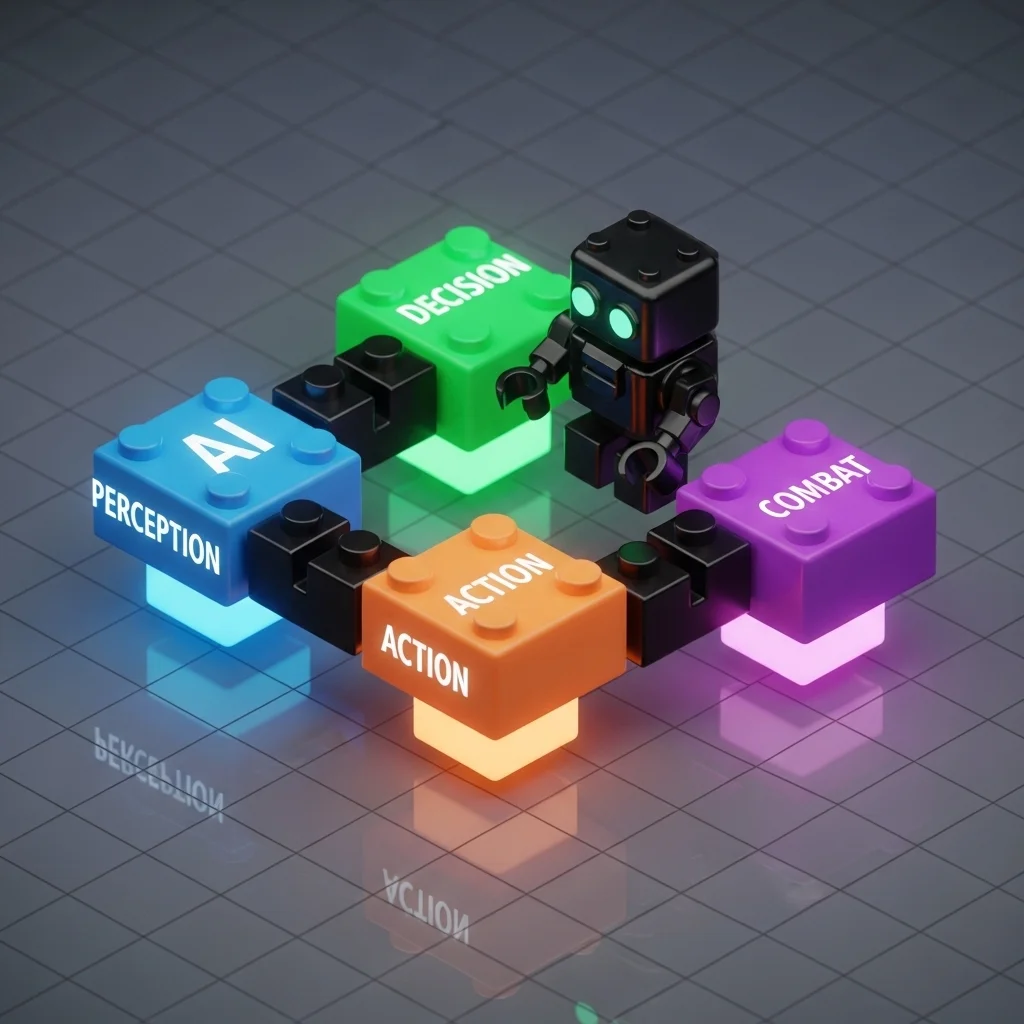
In game development, a modular AI system means breaking down character behaviors into independent, reusable components that can be mixed and matched. Instead of writing a monolithic “ZombieAI” class with everything hardcoded, you compose behaviors from smaller pieces: a perception module, a pathfinding module, a combat module, and so on.
Think of it like LEGO bricks. Each module does one thing well, has clear inputs and outputs, and can connect with other modules. A “chase player” module doesn’t care whether it’s attached to a zombie, a guard dog, or a robot it just needs target information and can output movement requests.
I first really understood this working on a game with over thirty enemy types. We started with unique scripts for each, which worked fine for the first five or six enemies. By enemy fifteen, we had massive code duplication. Bug fixes required hunting through multiple files. When the design team requested a new enemy that “acts like the brute but with ranged attacks like the sniper,” building it from scratch would’ve taken days. With modular systems, it took an afternoon.
The Core Components

Most modular game AI breaks down into a few fundamental systems that work together but remain independent.
Perception modules handle what a character knows about the world. Vision, hearing, damage sensing these are separate concerns. A zombie might have poor vision but excellent hearing. A security camera has perfect vision in a cone but no hearing at all. By separating these, you can mix them differently for each character type without rewriting the underlying logic.
Decision-making modules are where behavior trees, utility systems, or state machines live. This is the “brain” that processes perception data and chooses actions. The beautiful thing about modularity here is that different character types can use completely different decision-making approaches. Your simple enemies might use straightforward state machines while boss characters use complex utility systems, all within the same architectural framework.
Action modules execute decisions. These handle the actual movement, combat, animation triggering, and world interaction. A “take cover” action module finds appropriate cover positions and manages the movement there. It doesn’t care why the character decided to take cover or what enemy type it is—it just performs the action when requested.
Communication modules let AI characters coordinate. Squad tactics, alerting nearby allies, or calling for reinforcements these behaviors can be modular too. Some enemies might have no communication capability, others broadcast to everyone, while smart enemies use line-of-sight communication that players can disrupt.
Why This Matters in Practice
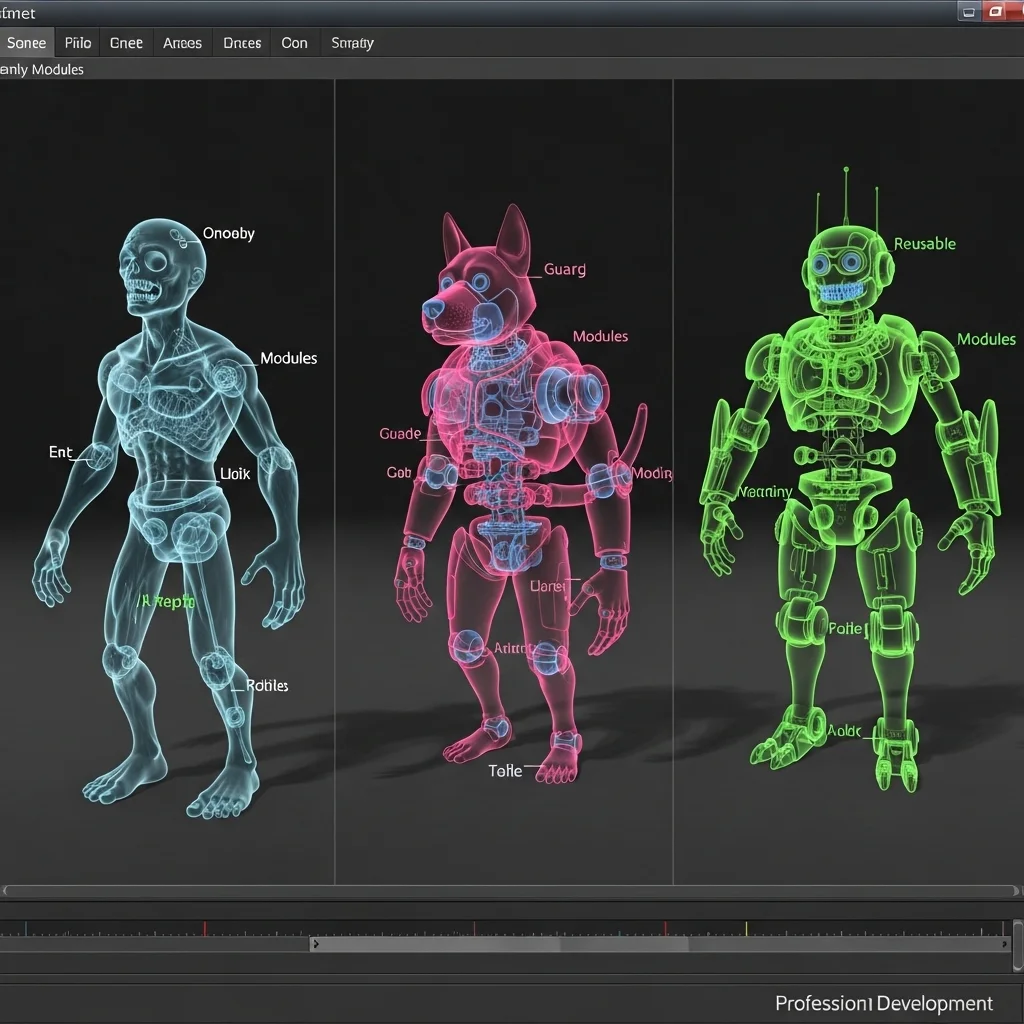
The first obvious benefit is reusability. When you’ve built a solid flanking module for one enemy type, using it on another is trivial. I’ve seen teams reduce development time for new enemy types by 60-70% once their modular systems matured. Designers can prototype new behaviors by combining existing modules in novel ways.
Debugging becomes manageable. When perception is broken, you know exactly where to look the perception module. You’re not hunting through thousands of lines of hybrid code trying to figure out why an enemy can see through walls. Each module can be tested independently, which is a godsend when you’re tracking down subtle bugs.
The flexibility is remarkable once you get used to thinking modularly. On one project, we had a possession mechanic where players could control enemies. Because our modules were independent, swapping out the decision-making module (replacing AI with player input) while keeping perception and action modules intact just… worked. Would’ve been a nightmare with monolithic AI scripts.
The Architecture Challenge
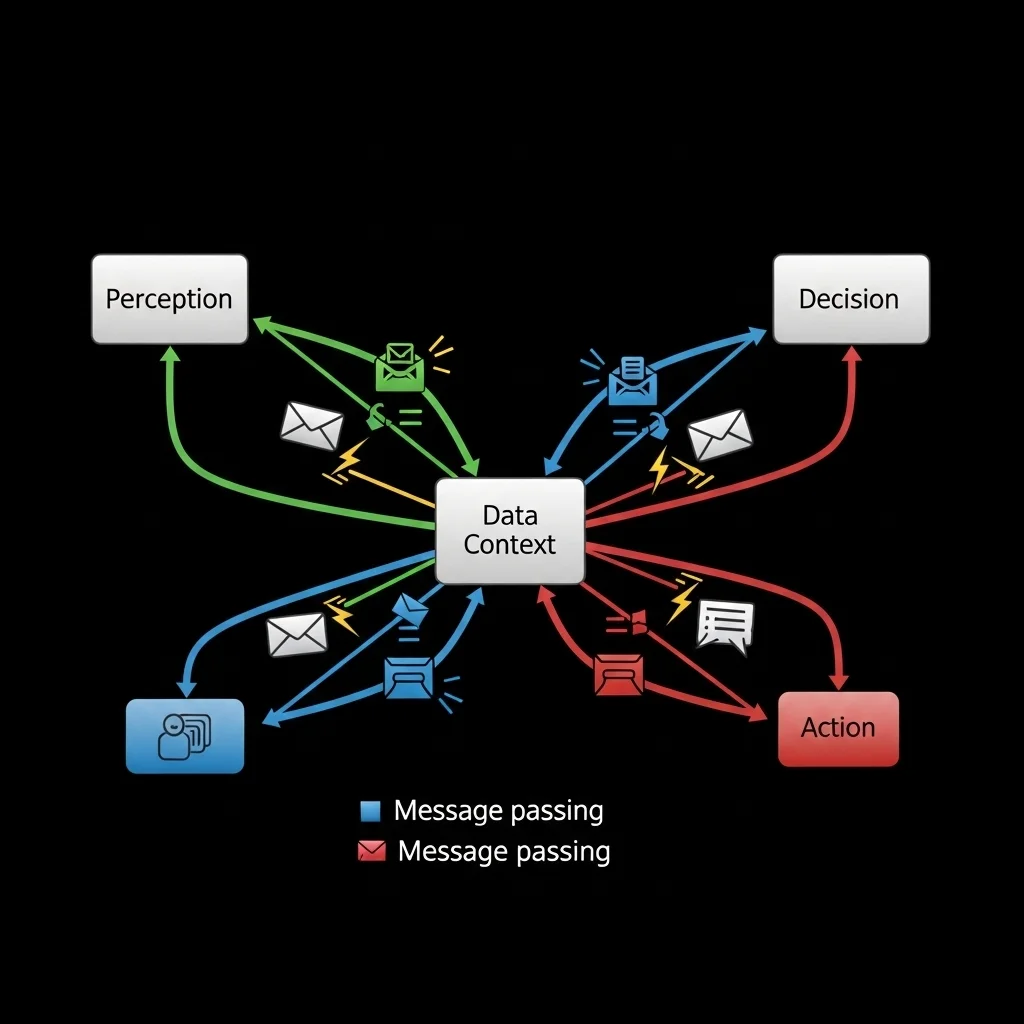
Here’s where theory meets messy reality: modules need to communicate, and that’s where things get complicated.
You can’t have completely isolated modules they need to share data. The decision module needs perception data. The action module needs to know what the decision module chose. I’ve seen teams overthink this and create elaborate message-passing systems with queues, priorities, and event buses that became harder to understand than the original spaghetti code.
The approach that’s worked best for me is shared data structures with clear ownership. Each AI entity has a data context essentially a struct or class holding relevant information. Perception modules write to it, decision modules read from it and write decisions, action modules read those decisions and execute them. Simple, cache-friendly, and easy to debug with a watch window.
Some teams use blackboard architectures where modules read and write to a shared blackboard without directly knowing about each other. This maximizes decoupling but can make data flow harder to trace. You gain flexibility but pay with debugging difficulty.
Real Implementation Patterns
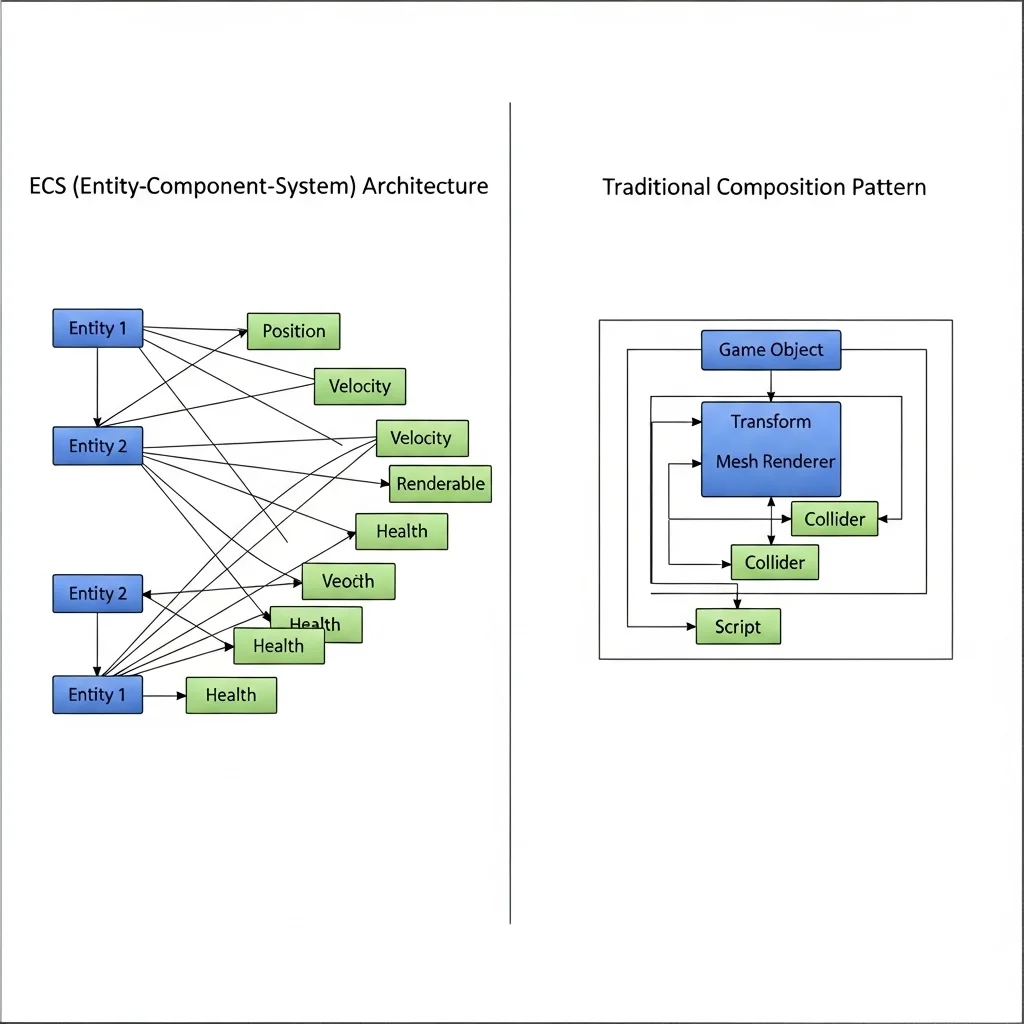
The Component-Entity-System (ECS) pattern has gained traction for modular AI, though it’s not the only way. Each AI entity is just an ID, and components (modules) attach to it. A guard might have VisualPerception, PatrolBehavior, and RangedCombat components. A dog has AudioPerception, ChaseBehavior, and MeleeCombat. Systems process all entities with relevant components each frame.
ECS encourages modularity almost by default and has excellent performance characteristics when implemented well. The downside is the mindset shift it’s very different from object-oriented AI scripting, and not everyone finds it intuitive.
I’ve also used composition-based approaches without full ECS. Each AI character has a list of behavior modules it owns, and a simple coordinator that queries them in sequence. Perception modules run first and populate the data context. Decision modules run next, choosing actions based on current state. Action modules execute last. It’s less sophisticated than ECS but easier for smaller teams to implement and maintain.
Common Pitfalls I’ve Seen

Over-engineering kills more modular systems than poor design. I’ve watched teams spend months building “the ultimate flexible AI framework” that could theoretically do anything, only to scrap it because nobody could actually use it. Start with the specific enemies you need now, identify the pieces worth modularizing, and build those. Expand as actual requirements demand.
Unclear module boundaries cause endless headaches. Should pathfinding live in the action module or be separate? Does the combat module handle target selection or just shooting? These seem like pedantic questions until three different programmers make different assumptions and everything breaks. Document your boundaries clearly and early.
Performance assumptions bite hard. Modular systems can be incredibly efficient or horribly slow depending on implementation. Calling virtual functions through interface boundaries every frame for every module for every enemy adds up. Data-oriented designs where modules process many entities in batch generally outperform object-oriented designs processing entities individually, but require more upfront architectural thought.
Making It Work For Your Team
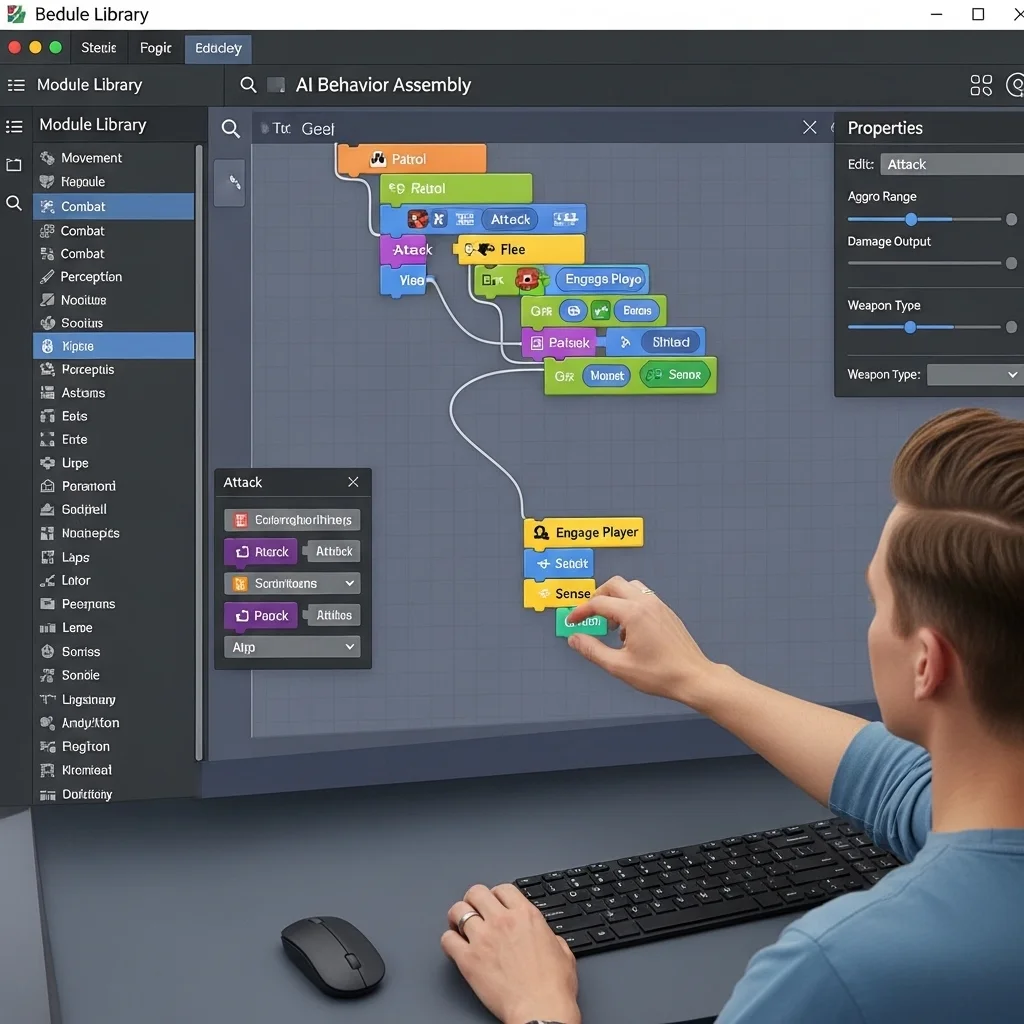
The best modular system is one your team will actually use. If your designers aren’t programmers, you need visual tools interfaces where they can add and configure modules without touching code. Unity and Unreal both support this reasonably well, but you’ll likely need custom tools for your specific modules.
Documentation matters more than usual with modular systems. Each module’s requirements, outputs, and assumptions need to be crystal clear. I maintain a wiki page for each major module with usage examples, common gotchas, and parameter explanations. It seems like overhead, but it saves so much time when someone new joins the team or designers are experimenting.
Balance flexibility with guardrails. Not every module combination makes sense. Maybe ranged combat requires visual perception, so your tools should prevent adding ranged combat without vision. Smart constraints prevent invalid configurations without limiting legitimate creativity.
Where We’re Heading

The trend toward visual scripting and node-based systems fits naturally with modular AI. Unreal’s Blueprint system, for instance, makes it relatively straightforward to build modular behaviors that designers can assemble visually. I expect we’ll see more engine-level support for modular AI patterns as they become standard practice.
Data-driven approaches are also gaining ground, where modules and their parameters live in external files rather than code. This enables runtime modding, easier balancing patches, and A/B testing different AI configurations. The cost is additional complexity in your data pipeline.
Final Thoughts

Modular AI systems aren’t a silver bullet, but they’re one of those rare cases where best practices actually deliver on their promises. The initial investment in thinking modularly and setting up proper architecture pays dividends throughout development and beyond.
Start small, focus on actual needs rather than theoretical flexibility, and build your system iteratively. Your future self debugging at midnight before a milestone will thank you.
Frequently Asked Questions
What’s the main benefit of modular AI systems?
Reusability and faster iteration. Once core modules exist, creating new enemy types or behaviors becomes far faster than building from scratch each time.
Is modular AI harder to implement than traditional approaches?
Initially, yes it requires more architectural planning. Long-term, it’s easier to maintain, debug, and extend than monolithic AI scripts.
Can I retrofit modularity into existing AI code?
Possible but painful. You’ll need to identify and extract reusable behaviors, which often requires significant refactoring. Better to start fresh if feasible.
What’s the performance impact of modular systems?
Depends entirely on implementation. Well-designed modular systems can be faster than monolithic code due to better data locality and batch processing. Poor implementations add overhead through excessive abstraction.
Do all game types benefit from modular AI?
Most do, but simple games with only a few enemy types may not need the complexity. The benefit increases with the number and variety of AI characters in your game.