
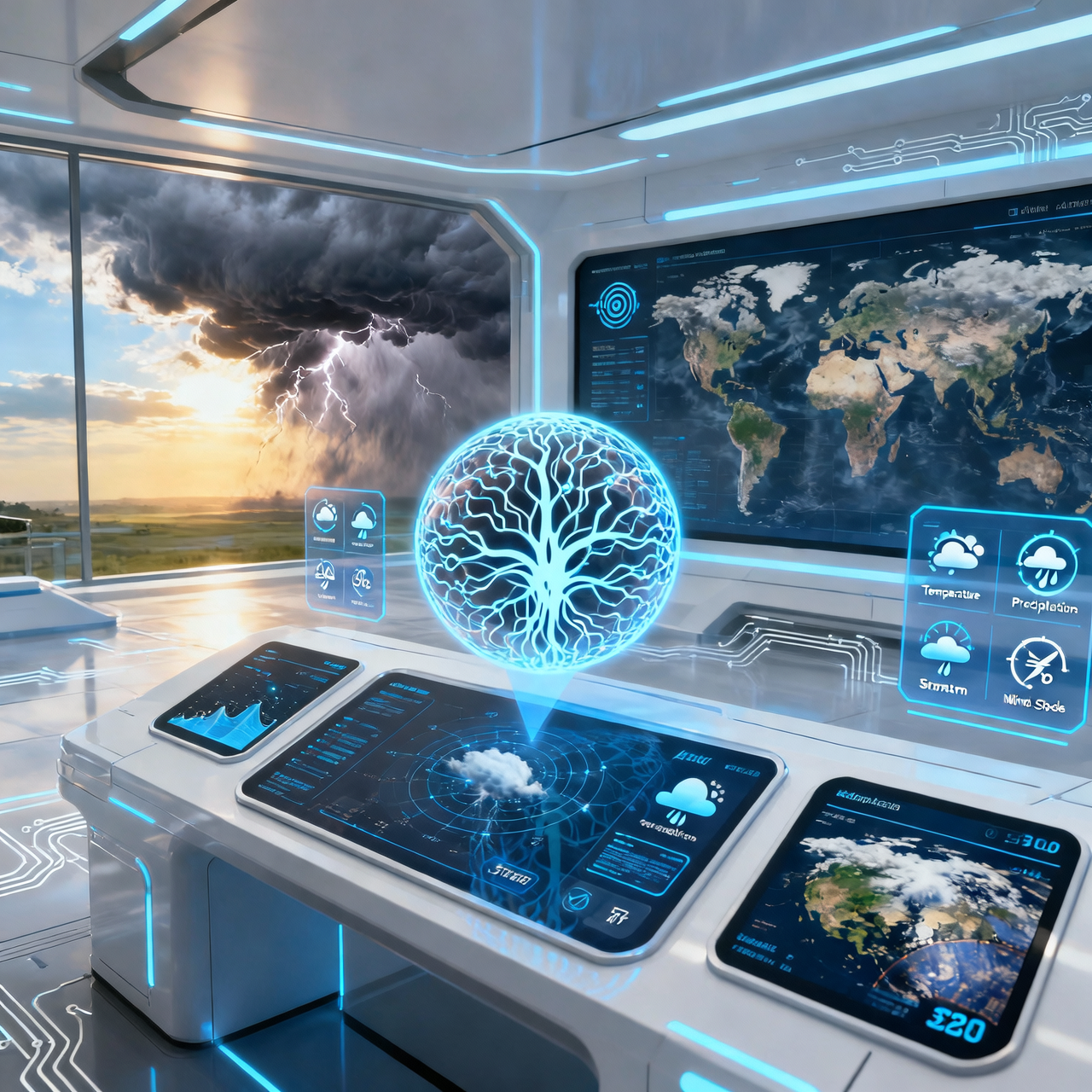
Three years ago, I watched a hurricane forecast update in real time as machine learning models processed incoming satellite data. The traditional models predicted landfall thirty miles north. The newer system disagreed. Twelve hours later, the storm hit almost exactly where the smart system had indicated.
That experience crystallized something I’d been suspecting for years. Weather prediction was undergoing its most significant transformation since the advent of numerical forecasting in the mid-twentieth century. And honestly, we’re still just getting started.
The Evolution From Gut Feelings to Intelligent Systems
Weather forecasting has always been about pattern recognition. Early meteorologists studied cloud formations and barometric pressure, developing intuition through observation. Computer models arrived in the 1950s and 1960s, crunching atmospheric equations to project future conditions. Each advancement improved accuracy incrementally.
Smart weather systems represent a different kind of leap. Rather than simply solving physics equations faster, these systems learn from massive datasets to identify patterns humans and traditional models miss. They process satellite imagery, radar returns, ground sensor networks, ocean buoy readings, and historical records simultaneously, finding correlations across variables we never thought to connect.
The technical foundation combines several approaches. Deep learning networks analyze visual data from weather satellites, recognizing storm formations and development patterns. Recurrent neural networks process time-series data to identify temporal patterns in atmospheric behavior. Ensemble methods combine multiple prediction approaches, learning which models perform best under specific conditions.
What emerges isn’t just faster forecasting. It’s fundamentally different forecasting.
Where This Technology Actually Delivers
Let me walk through concrete applications because the scope here is broader than most people realize.
Hyperlocal prediction has transformed dramatically. Traditional forecasts cover broad regions—your city might get the same prediction as areas fifty miles away. Smart weather systems leverage dense sensor networks and machine learning to predict conditions at neighborhood or even street level. Companies like Tomorrow.io and ClimaCell have built business models around this capability, serving industries where microclimates matter enormously.
Severe weather detection benefits tremendously from pattern recognition. Tornado prediction has improved as systems learn to identify radar signatures associated with tornadic development. I’ve spoken with emergency managers who describe receiving accurate warnings with significantly longer lead times than traditional systems provided even five years ago.
Aviation weather intelligence represents a critical application. Airlines lose billions annually to weather-related delays and diversions. Smart systems now predict clear-air turbulence, icing conditions, and convective activity with greater precision, enabling more efficient routing. Delta, United, and other major carriers have invested heavily in predictive weather platforms that adapt to real-time conditions.
Agricultural forecasting helps farmers make better decisions about planting, irrigation, and harvest timing. Systems trained on crop-weather relationships predict not just conditions but agricultural impacts frost probability, growing degree days, precipitation timing relative to crop cycles. Companies like aWhere and DTN specialize in this intersection.
Energy grid management increasingly depends on accurate renewable forecasting. Solar and wind generation fluctuate with weather conditions. Grid operators need precise predictions to balance supply and demand. Smart weather systems now forecast solar irradiance and wind patterns with accuracy that enables higher renewable penetration without compromising grid stability.
The Technical Advantages That Matter

Several capabilities distinguish smart weather systems from traditional approaches.
Processing unstructured data opens new information sources. Traditional models require structured numerical inputs. Machine learning systems can analyze satellite images directly, extracting meaningful patterns from visual information that would otherwise require extensive preprocessing.
Rapid model updating enables continuous improvement. When predictions prove wrong, smart systems learn from errors, adjusting their models automatically. Traditional systems require manual recalibration by specialists a slower, more resource-intensive process.
Ensemble optimization improves through experience. Rather than simply averaging multiple model outputs, intelligent systems learn which models perform best under specific atmospheric configurations, weighting contributions accordingly.
Computational efficiency expands capability. Some newer approaches produce forecasts in seconds that would take traditional physics-based models hours, enabling more frequent updates and longer-range outlooks.
Limitations That Deserve Honesty
Smart weather systems aren’t magical. Important constraints remain.
Data quality problems persist. Machine learning systems are only as good as their training data. Regions with sparse observation networks produce less reliable predictions. Historical data limitations affect training quality, particularly for rare extreme events.
Interpretability challenges concern many meteorologists. When a neural network makes a prediction, explaining why it reached that conclusion proves difficult. Traditional physics-based models show their work; smart systems often don’t. This creates trust barriers among operational forecasters.
Extreme event prediction remains problematic. The most severe weather events are also the rarest, meaning training datasets contain limited examples. Systems may underperform precisely when accurate forecasting matters most.
Overfitting risks can degrade real-world performance. Models that perform brilliantly on historical data sometimes fail when atmospheric conditions differ from training scenarios. Robust validation requires careful attention.
The Human Element Remains Essential
Here’s something I feel strongly about after watching this field evolve: smart weather systems enhance rather than replace human forecasters.
The best implementations I’ve observed combine machine intelligence with human expertise. Forecasters interpret model outputs, recognizing when systems might be overconfident or missing important factors. They communicate uncertainty effectively, translating probabilistic outputs into actionable guidance.
National Weather Service forecasters increasingly work alongside smart systems, using machine learning outputs as additional inputs to their decision-making. The hybrid approach outperforms either alone.
Looking Forward
The trajectory points toward increasingly integrated smart weather systems embedded throughout daily life.
Personal devices will deliver hyperlocal predictions tailored to your specific activities and risk tolerances. Infrastructure systems will respond automatically to predicted conditions—adjusting traffic signals, activating drainage systems, repositioning emergency resources.
Climate change amplifies the urgency. As atmospheric patterns shift and extreme events intensify, accurate prediction becomes more valuable and more challenging. Smart systems that learn from evolving conditions offer advantages over models calibrated to historical norms that no longer apply.
But the technology serves human needs only if it remains accessible and trustworthy. Ensuring prediction capabilities reach vulnerable communities, maintaining transparency about system limitations, and preserving human oversight over consequential decisions—these priorities must accompany technical advancement.
Weather has always humbled those who try to predict it. Smart systems have improved our capabilities remarkably, but nature retains the last word. The goal isn’t perfect prediction it’s better preparation for whatever skies deliver.
Frequently Asked Questions
What are smart weather systems?
They’re forecasting platforms that use machine learning to analyze atmospheric data and predict weather conditions with greater accuracy and precision than traditional methods alone.
How accurate are AI-based weather predictions?
Accuracy varies by timeframe and condition type, but studies show improvements of 10-30% over traditional models for certain forecast categories, particularly short-range and hyperlocal predictions.
Which industries benefit most from smart weather systems?
Aviation, agriculture, energy utilities, logistics, insurance, and emergency management see the most significant operational benefits from improved forecasting.
Do smart weather systems work for long-range forecasts?
They improve medium-range forecasts notably, but fundamental atmospheric chaos limits prediction accuracy beyond approximately two weeks regardless of methodology.
Are traditional weather models becoming obsolete?
No. Most effective approaches combine physics-based models with machine learning enhancements, leveraging strengths of both methodologies.
How do smart weather systems handle rare extreme events?
This remains a challenge. Limited training examples for rare events mean predictions may be less reliable precisely when accuracy matters most.