
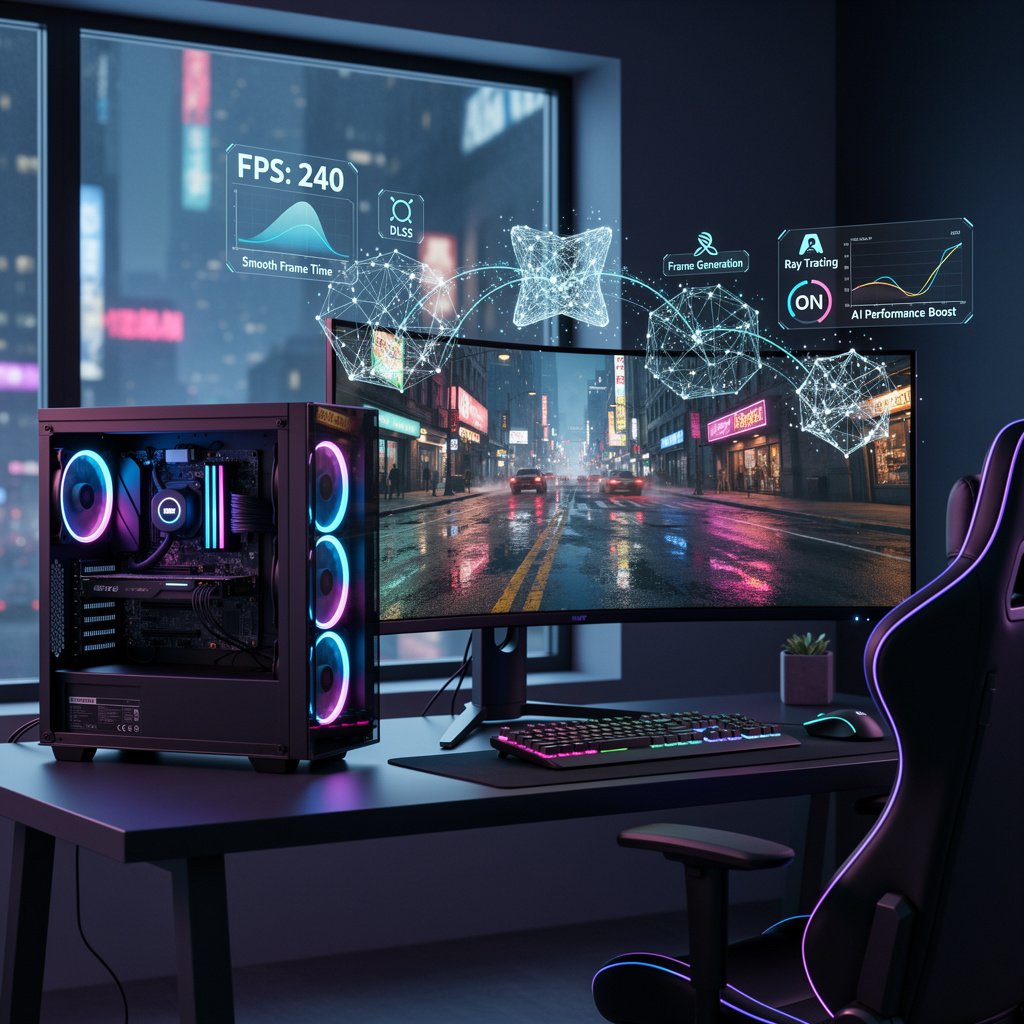
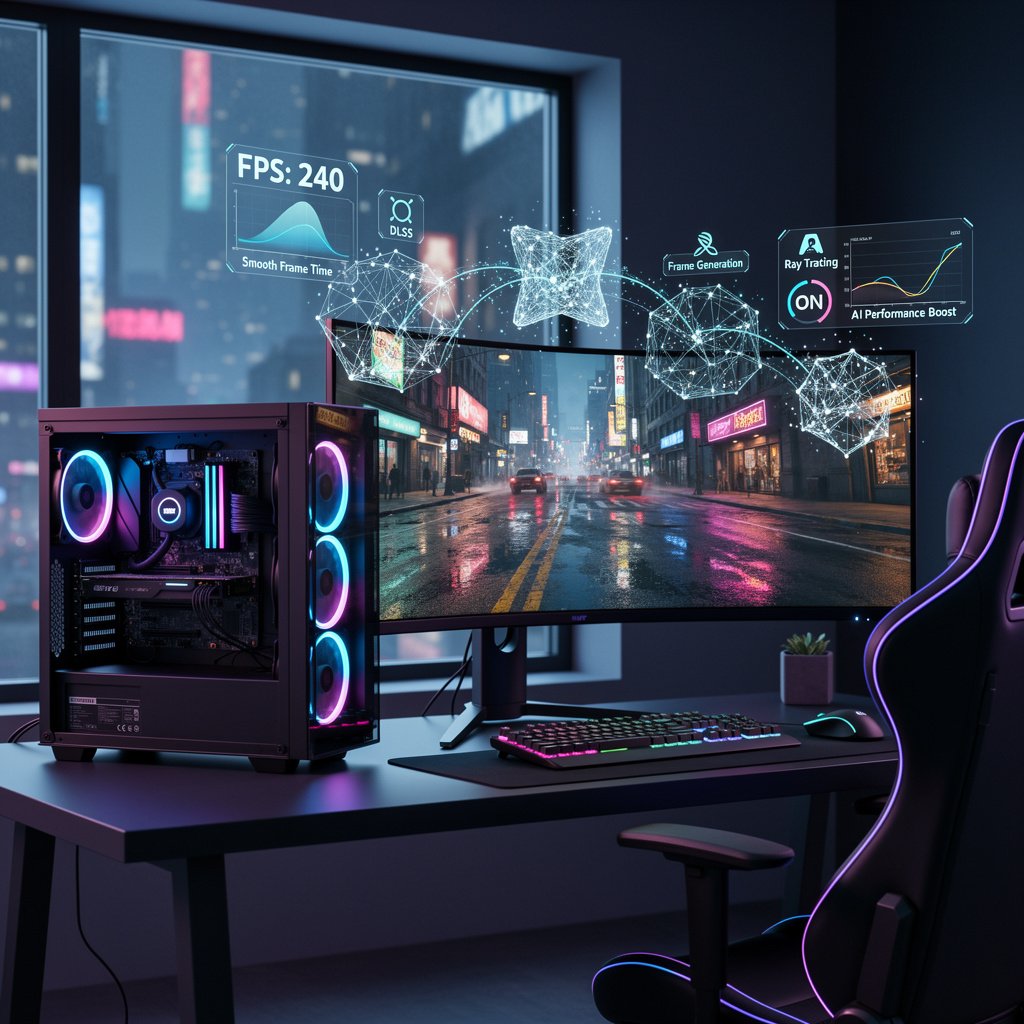
I remember the frustration vividly. It was 2019, and I’d just bought Cyberpunk 2077 with high hopes, only to watch my mid range GPU struggle at barely playable framerates. Fast forward to today, and that same scenario feels almost archaic. The gaming landscape has fundamentally shifted, largely thanks to artificial intelligence technologies that have quietly become the backbone of modern gaming performance.
The Rise of AI Powered Upscaling
Let’s start with what’s probably the most impactful development in recent gaming history: AI upscaling. NVIDIA’s Deep Learning Super Sampling, better known as DLSS, kicked off this revolution back in 2018, though early versions were admittedly rough around the edges.
The concept is deceptively simple. Instead of rendering games at native 4K resolution which hammers even the beefiest graphics cards the GPU renders at a lower internal resolution. Then, machine learning algorithms reconstruct the image to look nearly indistinguishable from native 4K. The performance gains are substantial; we’re talking 50-100% framerate improvements in many titles.
AMD responded with FidelityFX Super Resolution, and Intel brought XeSS to the table with their Arc graphics cards. Competition has been fierce, and gamers are the ultimate winners here.
Having tested dozens of games with these technologies enabled, I can confirm the difference is remarkable. Playing Alan Wake 2 at native 4K on my RTX 4070 would be a slideshow. With DLSS 3 enabled, I’m hitting smooth 60+ FPS with ray tracing cranked up. That’s not marketing speak it’s real world performance that transforms the gaming experience.
Frame Generation: The Controversial Game Changer
DLSS 3 introduced something even more ambitious: AI frame generation. The technology analyzes two consecutive frames and creates entirely new intermediate frames using neural networks. Essentially, your GPU renders half the frames, and artificial intelligence generates the rest.
The results are visually impressive. Games that would run at 60 FPS suddenly hit 120 FPS or higher. However, there’s a trade off worth discussing honestly input latency increases slightly because of this process. For competitive shooters where every millisecond counts, some players disable frame generation. For single player adventures or racing games, the smoother motion often outweighs the minor latency penalty.
I’ve found frame generation works exceptionally well in titles like Hogwarts Legacy and Spider Man Remastered. The fluidity enhancement genuinely makes gameplay feel more immersive, particularly during fast-paced sequences.
Intelligent Optimization Tools
Beyond real-time rendering improvements, AI has transformed how games optimize themselves. NVIDIA’s GeForce Experience and AMD’s Adrenalin software now use machine learning to analyze your hardware configuration and automatically suggest optimal settings.
These tools consider your specific GPU, CPU, available RAM, and target resolution to recommend settings that balance visual quality with performance. While not perfect sometimes they’re overly conservative they provide an excellent starting point for players who don’t want to spend hours tweaking individual settings.
Game developers are implementing similar technology directly into their engines. Unreal Engine 5, for instance, uses intelligent systems to dynamically adjust graphical fidelity based on what’s actually visible on screen. The Nanite virtualized geometry system essentially makes decisions in real-time about what level of detail each object needs.
Dynamic Difficulty and AI Opponents
Performance isn’t just about framerates. How smoothly a game plays also depends on balanced challenge levels and believable opponent behavior.
Modern games increasingly use machine learning to adapt difficulty dynamically. Left 4 Dead pioneered this approach with its Director system, but current implementations are far more sophisticated. Games like Resident Evil 4 Remake subtly adjust enemy aggression, item drops, and spawn locations based on how you’re performing all without obvious difficulty spikes.
Enemy AI has improved dramatically too. Machine learning helps create opponents that learn from player behavior rather than following predictable patterns. Ghost of Tsushima’s dueling system, for example, feels remarkably responsive because enemies adapt their strategies based on your combat tendencies.
Anti Cheat Systems Powered by Machine Learning
Here’s an area that doesn’t get enough attention: AI powered anti-cheat systems. Traditional anti cheat software relies on signature detection essentially looking for known hacks. Cheaters constantly evolve their tools, creating an endless cat and mouse game.
Machine learning flips this approach. Instead of looking for specific cheat signatures, AI systems analyze player behavior patterns. Aim movements that are unnaturally precise, reaction times that exceed human capability, or movement patterns that suggest wall hacking all get flagged automatically.
Valve’s VACnet, used in Counter Strike 2, exemplifies this approach. The system reviews thousands of matches daily, identifying suspicious behavior with impressive accuracy. Similar technology powers Activision’s RICOCHET anti cheat for Call of Duty.
Real Limitations Worth Acknowledging
I’d be doing you a disservice not mentioning limitations. AI upscaling sometimes introduces visual artifacts ghosting in fast moving scenes or slight blurring of fine details. These issues have improved dramatically with newer versions, but they’re not entirely eliminated.
Frame generation, while impressive, doesn’t actually reduce your GPU’s rendering workload. It just adds more frames between rendered ones. Your base performance still matters significantly.
Additionally, many of these technologies require specific hardware. DLSS 3’s frame generation only works on RTX 40 series cards. FSR is more accessible but produces slightly inferior results compared to DLSS in most comparisons I’ve conducted.
Looking Forward
The trajectory is clear and exciting. Each generation of AI powered gaming technology shows meaningful improvements. DLSS 4 promises even better reconstruction quality and broader game support. Meanwhile, developers are exploring AI tools that could help smaller studios create more polished games with limited budgets.
We’re approaching an era where hardware limitations become less restrictive. A modest gaming PC today delivers experiences that would have required expensive enthusiast hardware just three years ago. That democratization of high-quality gaming is perhaps artificial intelligence’s greatest contribution to this industry.
Frequently Asked Questions
Does AI upscaling work with any graphics card?
AMD’s FSR works on most modern GPUs regardless of brand. NVIDIA’s DLSS requires RTX graphics cards specifically, while Intel’s XeSS is optimized for Arc GPUs but works on other hardware.
Will AI upscaling hurt my image quality?
Modern implementations like DLSS 3.5 and FSR 3 produce images nearly indistinguishable from native resolution. Quality mode settings typically maintain excellent visuals while boosting performance significantly.
Does frame generation increase input lag?
Yes, slightly. Most players won’t notice in single-player games, but competitive multiplayer gamers might prefer disabling it for maximum responsiveness.
Can AI anti-cheat falsely ban innocent players?
While rare, false positives can occur. Most systems flag suspicious behavior for review rather than issuing automatic bans, reducing innocent player impact.
Is AI performance technology free to use?
Yes. DLSS, FSR, and XeSS are free features that developers implement into their games. Players simply need compatible hardware and updated drivers.