
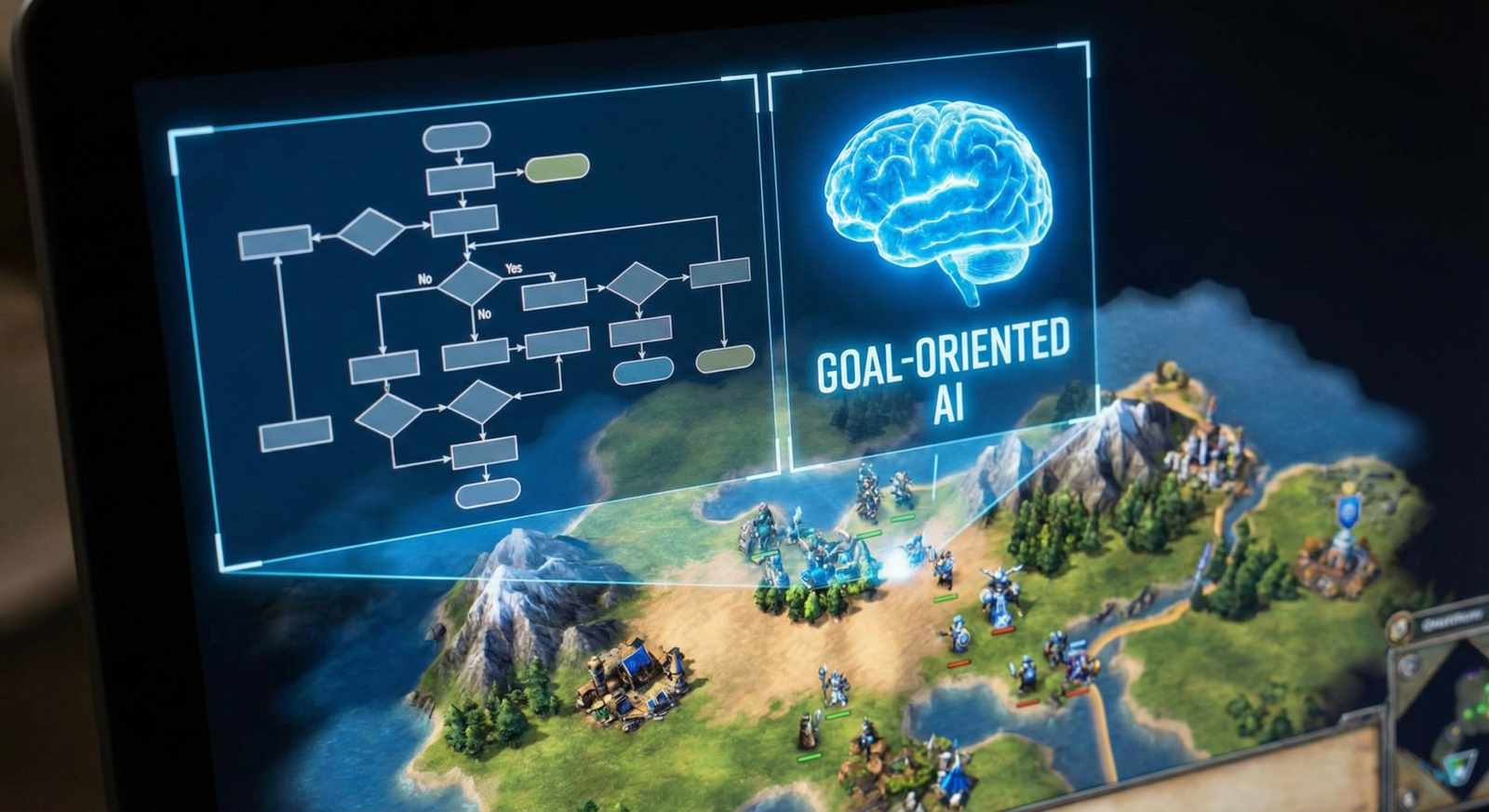
The first time I saw goal oriented AI in action was during a playtest of a tactical shooter I was consulting on back in 2014. An enemy soldier needed to reach the player but found his path blocked by a locked door. Instead of standing there stupidly or picking from predetermined animations, he assessed his options, grabbed a nearby fire extinguisher, smashed the window beside the door, and climbed through. Nobody scripted that specific sequence. The AI figured it out.
That moment sold me on goal oriented action planning.
Understanding Goal Oriented Action Planning
Goal oriented AI, commonly called GOAP, represents a fundamentally different approach to game character intelligence. Rather than telling characters exactly what to do in every situation, you give them goals to achieve and actions they can perform. The AI figures out how to connect those actions to reach the goal.
Traditional finite state machines require developers to anticipate every scenario. Miss one transition, and characters break. GOAP flips this around. You define what success looks like and what tools exist. The planning system handles the rest.
Think about how you’d get coffee from your kitchen. You don’t follow a rigid script. You assess the situation is there coffee made? Are there clean cups? Is the machine on? Based on current conditions, you chain together whatever actions make sense. GOAP mimics this natural problem-solving process.
How the Planning System Works
The core components of goal-oriented AI are straightforward, though implementation gets complex quickly.
World State represents everything relevant about the current situation. For a combat AI, this might include: has weapon, weapon loaded, target visible, in cover, health level, ammunition count. World state is just a collection of true/false or numeric values.
Goals define desired world states. “Target eliminated” might mean target_alive = false. “Self preserved” might mean health > 0 and in_cover = true. Each goal has priority, often calculated dynamically based on circumstances.
Actions are things the character can do. Every action has preconditions (what must be true to perform it) and effects (how it changes world state). The action “Reload Weapon” might require has weapon = true and ammo_available = true, with the effect weapon_loaded = true.
The planning algorithm typically a variant of A* search works backward from the goal. What action would achieve this goal state? What preconditions does that action need? What actions satisfy those preconditions? This continues until the planner finds a sequence connecting current world state to the goal.
F.E.A.R.: The Game That Changed Everything
You can’t discuss goal oriented AI without mentioning F.E.A.R., the 2005 shooter from Monolith Productions. Jeff Orkin’s implementation of GOAP for enemy soldiers became legendary in game development circles.
The soldiers in F.E.A.R. didn’t just feel smart they were genuinely solving problems. They’d flush you out with grenades, provide covering fire for flanking teammates, retreat when outgunned, and adapt when plans fell apart. Players swore the AI was cheating. It wasn’t. The soldiers were simply planning effectively.
What made F.E.A.R.’s system remarkable was emergent behavior. Orkin and his team never scripted specific tactical maneuvers. They gave soldiers goals (kill the player, survive) and actions (move to cover, fire weapon, throw grenade, call for backup). The dynamic, coordinated combat emerged from individual soldiers planning toward their goals while responding to changing circumstances.
I’ve studied that system extensively. The documentation Orkin published afterward became required reading for anyone serious about game AI.
Advantages Over Traditional Approaches
Having worked with FSMs, behavior trees, and GOAP across different projects, I can speak to the practical differences.
Flexibility stands out immediately. Adding new actions automatically creates new possible behaviors. Give an AI the ability to pick locks, and suddenly locked doors become solvable without explicitly coding that scenario. The planner discovers it.
Reduced authoring burden matters enormously on larger projects. With state machines, doubling your character’s capabilities might quadruple your transition logic. With GOAP, you’re adding actions, not exponentially growing connections.
Emergent behavior produces moments that surprise even developers. Characters combine actions in unexpected ways. This emergent quality makes games feel more alive and less predictable.
Debugging clarity improves in some ways. When an AI makes a strange decision, you can examine its plan the goal it was pursuing, the actions it chained together, the world state it perceived. The reasoning is explicit.
The Real Challenges
Let me be honest about the difficulties, because GOAP isn’t a silver bullet.
Performance concerns are legitimate. Planning is computationally expensive. Running A* search through action space for dozens of NPCs every frame isn’t feasible. Most implementations cache plans and only replan when world state changes significantly or plans fail.
Action design requires careful thought. Poorly designed preconditions and effects create broken plans or infinite loops. Actions need to actually achieve what their effects claim, and preconditions must accurately reflect requirements.
Predictability suffers compared to scripted behaviors. When directors or designers need exact sequences for narrative moments, GOAP’s flexibility becomes a liability. Most games use GOAP for systemic gameplay but switch to scripted behaviors for key story beats.
Learning curve is steep. Teams familiar with state machines need time to internalize goal-oriented thinking. Early implementations often replicate FSM patterns awkwardly before developers truly grasp the paradigm shift.
Modern Applications and Evolution

Shadow of Mordor’s Nemesis system incorporated goal oriented principles, letting orc captains pursue personal vendettas and ambitions. The AI characters felt like they had agendas beyond just attacking the player.
Recent immersive sims like Dishonored and Prey use hybrid approaches, combining GOAP concepts with other techniques. Pure GOAP is rare in shipped games; practical implementations usually blend methodologies.
Strategy games increasingly adopt goal oriented AI for opponent decision-making. Rather than scripted build orders, AI commanders plan toward victory conditions, adapting to player actions dynamically.
When Should You Use GOAP?
Goal-oriented AI shines in specific contexts:
- Games emphasizing emergent gameplay
- Tactical situations requiring adaptive responses
- Characters needing varied problem-solving approaches
- Projects where designer iteration on behaviors is frequent
It’s probably overkill for simple enemies with predictable patterns. Tower defense creeps don’t need to plan. Neither do most puzzle game elements or basic platformer enemies.
Match the AI complexity to your game’s needs. Sometimes a well designed state machine outperforms an elaborate planning system, simply because it’s appropriate for the challenge.
Final Perspective
Goal oriented AI represents one of the more elegant solutions in game development. When it works well, characters feel genuinely intelligent. They reason, adapt, and surprise you.
But elegance doesn’t mean ease. Implementing robust GOAP requires significant investment. The payoff comes in games where that adaptability genuinely improves player experience.
I’ve never regretted learning this paradigm. Even when I choose simpler approaches for specific projects, understanding how goal oriented systems work informs better AI design across the board.
Frequently Asked Questions
What’s the main difference between GOAP and behavior trees?
Behavior trees execute predefined logic trees with priority rules. GOAP dynamically constructs action sequences to achieve goals. GOAP is more flexible but more computationally expensive.
Is goal-oriented AI only useful for combat scenarios?
No. It works for any situation requiring adaptive problem-solving NPC daily routines, resource gathering, puzzle solving, or social interactions.
How expensive is GOAP computationally?
Planning is relatively costly. Most games limit replanning frequency and use hierarchical approaches to manage performance.
Can GOAP and finite state machines work together?
Absolutely. Many implementations use GOAP for high-level decision-making while individual actions execute as small state machines.
What games should I study to understand GOAP better?
F.E.A.R. remains the classic example. Shadow of Mordor, Tomb Raider (2013), and several indie titles also demonstrate these principles well.
Is GOAP difficult to implement from scratch?
Moderately difficult. The core algorithm isn’t complex, but designing coherent action sets and handling edge cases requires experience and iteration.