
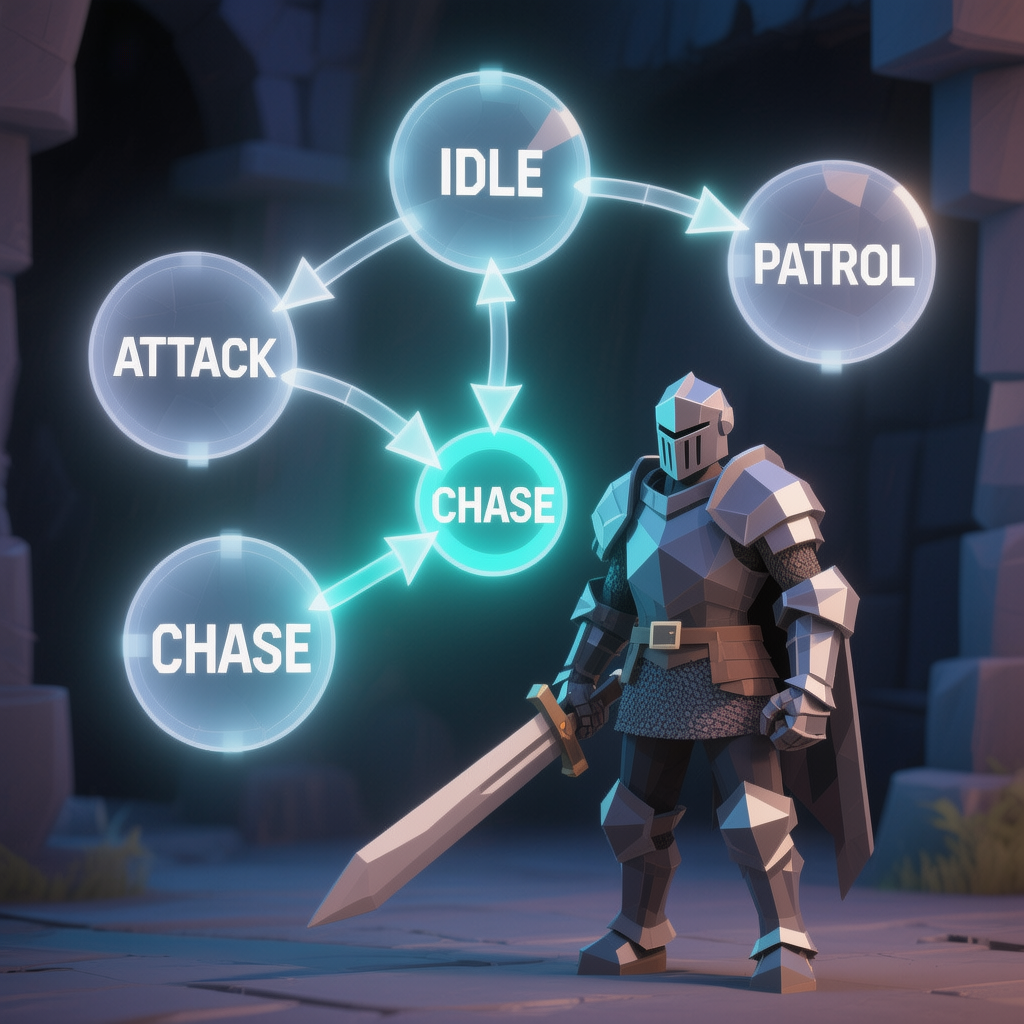
Back in 2011, I was working on my first serious game project a top-down zombie survival game. The zombies were supposed to patrol, chase players, and attack. Simple enough, right? My first attempt involved a tangled mess of if-else statements that became impossible to debug. A senior developer looked at my code, laughed, and introduced me to finite state machines. That conversation changed how I approached game AI forever.
What Exactly Is a Finite State Machine?
A finite state machine, commonly called an FSM, is a computational model that can exist in exactly one state at any given moment. Think of it like a traffic light. It’s either red, yellow, or green never two colors simultaneously. The light transitions between these states based on specific conditions, like a timer or sensor input.
In game AI, FSMs provide structure to character behavior. Instead of writing spaghetti code with nested conditions, you define distinct behavioral states and the rules for moving between them. An enemy guard might have states like Patrol, Alert, Chase, Attack, and Return. Each state contains its own logic, and transitions happen when certain conditions are met.
Why Game Developers Love FSMs
The beauty of finite state machines lies in their simplicity and predictability. When you’re debugging why an NPC keeps walking into walls, knowing exactly which state it’s in makes troubleshooting straightforward. You’re not hunting through dozens of conditional branches.
I’ve shipped three commercial games using FSM based AI systems. The pattern works remarkably well for:
- Enemy NPCs with patrol and combat behaviors
- Companion characters that follow, wait, or assist
- Boss fights with distinct attack phases
- Interactive objects like doors, elevators, and turrets
- Quest-related characters that change behavior based on story progress
The famous ghosts in Pac-Man? Those are essentially FSMs. Each ghost has states like Chase, Scatter, and Frightened. When Pac-Man eats a power pellet, all ghosts transition to the Frightened state. Simple, elegant, and memorable even forty years later.
Anatomy of a Game AI State Machine
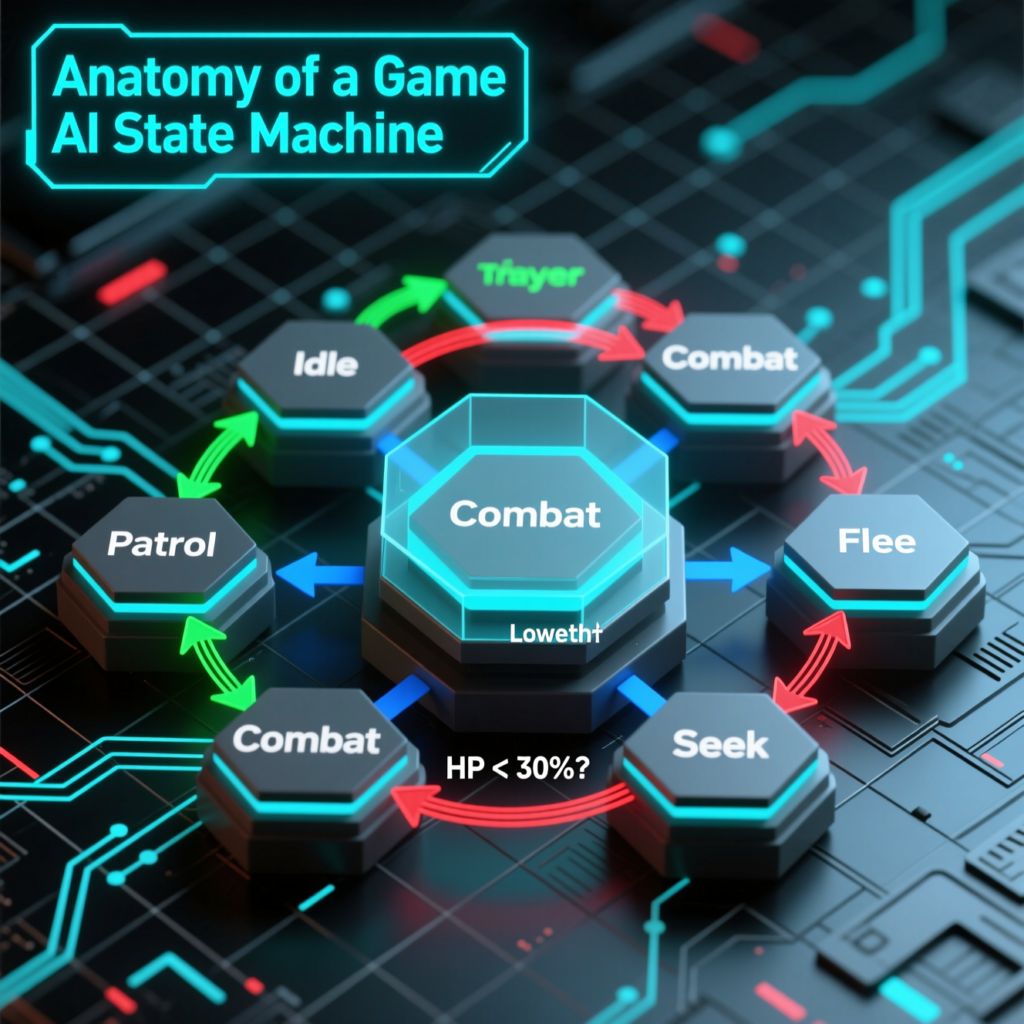
Let me walk through a practical example. Say we’re building a guard AI for a stealth game.
States:
- Patrol: Walking predetermined routes
- Suspicious: Heard something, investigating
- Alert: Spotted the player, calling for backup
- Chase: Actively pursuing the player
- Attack: Close enough to engage
- Search: Lost sight, checking last known location
- Return: Going back to patrol route
Transitions:
Each state needs exit conditions. From Patrol, the guard might transition to Suspicious if noise exceeds a threshold, or directly to Alert if they spot the player. From Chase, they transition to Attack when within melee range, or to Search if the player breaks line of sight for five seconds.
The key insight here is that transitions are the soul of the system. Poorly designed transitions create robotic, predictable AI. Well-crafted ones produce behavior that feels intelligent and reactive.
Implementation Approaches
There’s no single correct way to implement FSMs in games. I’ve used several approaches depending on project requirements.
Switch statements work fine for simple characters. Your update loop checks the current state and executes corresponding logic. It’s quick to implement but becomes unwieldy with more than five or six states.
State pattern from object oriented design treats each state as its own class. States handle their own enter, update, and exit logic. This scales better and keeps code organized but introduces more overhead.
Data-driven systems define states and transitions in external files JSON, XML, or custom formats. Designers can tweak AI behavior without touching code. This approach requires more upfront investment but pays dividends on larger projects.
Most modern game engines include some form of FSM support. Unity’s Animator, while designed for animation, essentially functions as a visual FSM editor. Unreal Engine’s Behavior Trees supersede FSMs for complex AI but incorporate state-like concepts.
Limitations Worth Acknowledging
FSMs aren’t perfect. Once you’ve worked with them extensively, you notice the cracks.
State explosion is real. As characters need more nuanced behavior, state counts multiply. A guard that can swim, climb, and use vehicles might need dozens of states covering every combination. Managing transitions between all these states becomes nightmarish.
Rigidity is another concern. FSMs react to current conditions but lack memory of past events or anticipation of future ones. An FSM guard spotted you, chased you, lost you, and returned to patrol. They don’t remember being suspicious earlier or anticipate you might circle back.
Parallel behaviors require workarounds. What if your character needs to walk AND talk AND track potential threats? Pure FSMs handle one state at a time. Hierarchical state machines or layered systems help but add complexity.
For these reasons, many studios have moved toward behavior trees, utility AI, or goal oriented action planning for sophisticated characters. Still, FSMs remain excellent for simpler entities or as components within larger AI architectures.
When FSMs Remain the Right Choice
Despite newer techniques, I still reach for FSMs regularly. They’re ideal when:
- Behavior complexity is moderate
- States are clearly definable
- Predictability matters (puzzle games, deterministic systems)
- Development time is limited
- Team members lack AI specialization
Boss fights particularly suit FSMs. Phase-based combat where bosses change attack patterns at health thresholds maps perfectly to state machines. Players subconsciously recognize and learn these patterns, which creates satisfying gameplay loops.
Final Thoughts
Finite state machines won’t revolutionize your game AI. They’re not cutting-edge or particularly impressive on a resume. But they work, they’re understandable, and they ship games. After fifteen years of development work, I’ve learned that reliable, debuggable systems beat clever solutions every time.
Start simple. Build a basic FSM for an enemy character. Watch how easily you can add states and tweak behaviors. You’ll understand why this decades-old pattern remains foundational to game AI development.
Frequently Asked Questions
What programming languages work best for implementing FSMs in games?
Any language works. C++, C#, Python, and GDScript all support FSMs effectively. The pattern is language-agnostic.
Are finite state machines outdated for modern game development?
No. They remain widely used for simpler AI, animation systems, and game state management. Complex AI might use other techniques, but FSMs persist.
How many states should a typical enemy AI have?
Five to ten states usually suffice for standard enemies. More complex characters might have fifteen to twenty. Beyond that, consider hierarchical FSMs or alternative approaches.
What’s the difference between FSMs and behavior trees?
FSMs exist in one state at a time with explicit transitions. Behavior trees evaluate conditions dynamically and can execute multiple branches. Behavior trees handle complexity better but require more learning.
Can FSMs handle multiplayer game AI?
Absolutely. FSMs work fine in networked games. State synchronization across clients requires careful implementation, but the pattern itself remains valid.
Should I build my own FSM system or use existing tools?
For learning, build your own. For production, leverage engine tools or proven libraries. Most game engines include visual state machine editors worth using.