
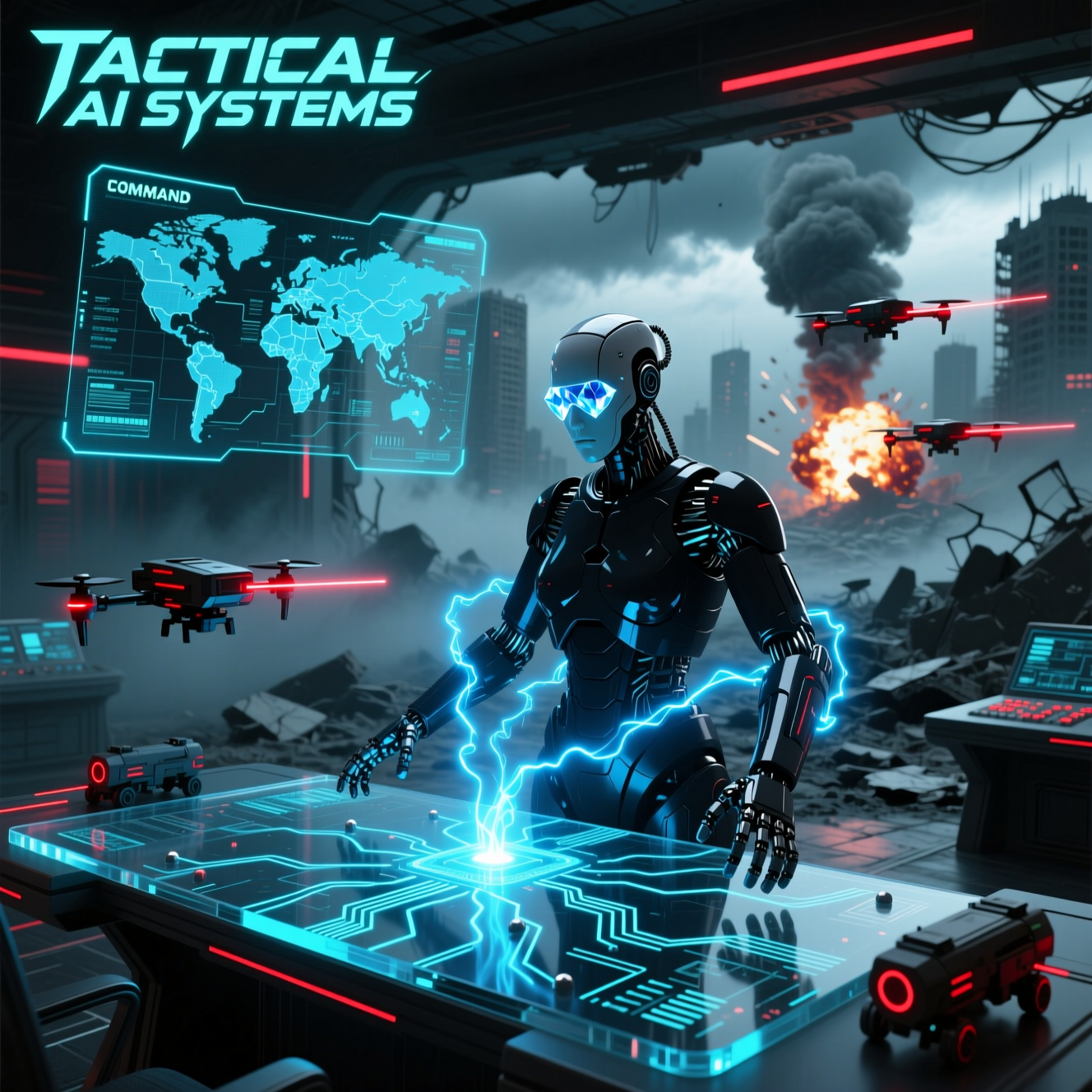
I still remember the moment a squad of enemies in F.E.A.R. genuinely surprised me. They didn’t just rush my position like braindead cannon fodder. One soldier laid down suppressing fire while two others flanked around a stack of crates I was using for cover. When I retreated through a doorway, another was already waiting. I died, but I was grinning. That was 2005, and tactical AI had just announced itself as something special.
Understanding Tactical AI in Video Games
Tactical AI refers to the decision-making systems that control non player characters in combat and strategic scenarios. Unlike simple patrol routines or scripted sequences, tactical AI evaluates situations dynamically and responds with coordinated, intelligent behavior.
This isn’t about making enemies impossibly difficult. It’s about making them feel real. When an enemy soldier ducks behind cover instead of standing in the open, that’s tactical AI. When a group coordinates an ambush, uses grenades to flush you out, or retreats when outgunned that’s the system working as intended.
The distinction matters because players can immediately sense the difference. Dumb enemies break immersion. Smart ones create tension, satisfaction, and memorable moments.
The Evolution From Simple to Sophisticated
Early games had extremely basic enemy behavior. Enemies in Doom essentially moved toward you and attacked. No cover usage, no coordination, no self-preservation. The challenge came from numbers and level design, not intelligence.
Things started shifting in the late 1990s. Half Life received widespread praise for enemies that seemed to communicate and work together. Those HECU soldiers would call out player positions, throw grenades at hiding spots, and occasionally retreat to regroup. By today’s standards, it’s relatively simple. Back then, it felt revolutionary.
The real watershed moment came with F.E.A.R. in 2005. Monolith Productions implemented a goal-oriented action planning system that gave enemies remarkable flexibility. Rather than following predetermined scripts, these soldiers evaluated their options in real-time. The result was emergent tactical behavior that surprised even the developers during playtesting.
How These Systems Actually Work

Without getting too deep into programming weeds, tactical AI typically relies on several interconnected systems.
Behavior trees form the backbone of many implementations. Think of them as decision flowcharts that evaluate conditions and select appropriate actions. An enemy might check: Am I being shot at? Yes. Do I have cover nearby? Yes. Move to cover. No cover? Return fire while retreating.
Influence maps help AI understand spatial relationships. These invisible overlays track things like danger zones, player sight lines, and strategic positions. When an enemy “decides” to flank, it’s often because the influence map indicated a low-danger path to a high value position.
Squad coordination requires another layer entirely. Individual tactical decisions need to mesh with group behavior. Someone needs to suppress. Someone needs to advance. Systems like blackboard architecture allow AI units to share information and claim roles dynamically.
What developers have learned over decades is that believable tactical behavior often comes from combining simple systems rather than building one complex monolith. Emergent intelligence arises from the interaction of straightforward rules.
Standout Examples Worth Studying
The Halo series deserves recognition for enemy variety and readability. Each Covenant species behaves differently Grunts panic and flee when Elites die, Jackals turtle behind shields, Hunters coordinate in pairs. Players learn to read these behaviors and adapt accordingly.
XCOM and its sequel demonstrate tactical AI in turn based contexts. Enemy units use cover effectively, prioritize wounded targets, and employ class-specific abilities strategically. On higher difficulties, the alien forces feel genuinely threatening rather than artificially buffed.
Total War games face the massive challenge of coordinating hundreds or thousands of units simultaneously. The AI must handle formation, morale, terrain advantage, and combined arms tactics across sprawling battlefields. It doesn’t always succeed, frankly, but when it works, battles feel appropriately epic.
More recently, games like Deep Rock Galactic show how tactical behavior applies to non humanoid enemies. Swarms of alien bugs exhibit emergent tactical patterns flanking, surrounding, prioritizing isolated players despite being relatively simple individually.
The Ongoing Challenges
Creating convincing tactical AI remains genuinely difficult. Several persistent problems plague developers.
Performance constraints are constant. Sophisticated decision making requires processing power. When you’ve got dozens of enemies onscreen, each running complex evaluation systems, frame rates suffer. Optimization becomes crucial, often meaning simplifications that reduce behavioral depth.
Balancing entertainment against realism creates tension. Perfectly optimal AI would be frustrating to play against. Enemies that always hit, never make mistakes, and exploit every weakness wouldn’t be fun. Developers intentionally introduce limitations and “mistakes” to keep gameplay enjoyable.
Playtesting tactical AI is notoriously challenging. These systems can produce unexpected emergent behaviors. I’ve heard developers describe enemies that learned exploits players hadn’t discovered, or coordinated tactics that made encounters nearly impossible. Finding these issues requires extensive testing across countless scenarios.
The “uncanny valley” of intelligence also exists. AI that’s almost smart but makes occasional obvious mistakes can feel more frustrating than AI that’s consistently simple. Players have expectations, and violating them feels cheap.
Current Trends and Directions
Modern tactical AI increasingly emphasizes readability and personality. Players should understand why enemies behave certain ways. Visual and audio cues callouts, gestures, distinct behavior patterns help communicate AI decision making.
Adaptive difficulty systems have become more sophisticated. Rather than simply adjusting health and damage, modern implementations modify tactical behavior. Struggling players face enemies that make more mistakes, while skilled players encounter more coordinated opposition.
Machine learning approaches are entering the conversation, though practical implementations remain limited. Training AI through simulated play sessions could theoretically produce more nuanced behavior, but computational costs and unpredictability create barriers.
The Human Element
Here’s what I’ve come to appreciate after years of observing this field: the best tactical AI isn’t about raw intelligence. It’s about crafting experiences that feel fair, surprising, and satisfying.
Players want enemies that challenge them, but not enemies that feel like cheating. They want tactical situations that reward smart play. Most importantly, they want opponents that feel alive.
That’s the real art behind tactical AI systems not just programming intelligence, but programming believable adversaries worth fighting against.
FAQs
What is tactical AI in video games?
Decision making systems that control enemy behavior in combat, enabling coordinated actions like flanking, using cover, and responding dynamically to player actions.
Which games have the best tactical AI?
F.E.A.R., Halo series, XCOM 2, and The Last of Us are frequently cited for excellent tactical enemy behavior.
Why don’t all games have smart enemy AI?
Performance constraints, development time, and balancing fun versus realism all limit tactical AI implementation.
Does tactical AI use machine learning?
Currently, most games use traditional systems like behavior trees. Machine learning applications exist but aren’t widespread due to unpredictability and computational costs.
Can tactical AI be too good?
Yes developers intentionally limit AI to maintain fun. Perfectly optimal enemies would frustrate most players rather than challenge them enjoyably.