
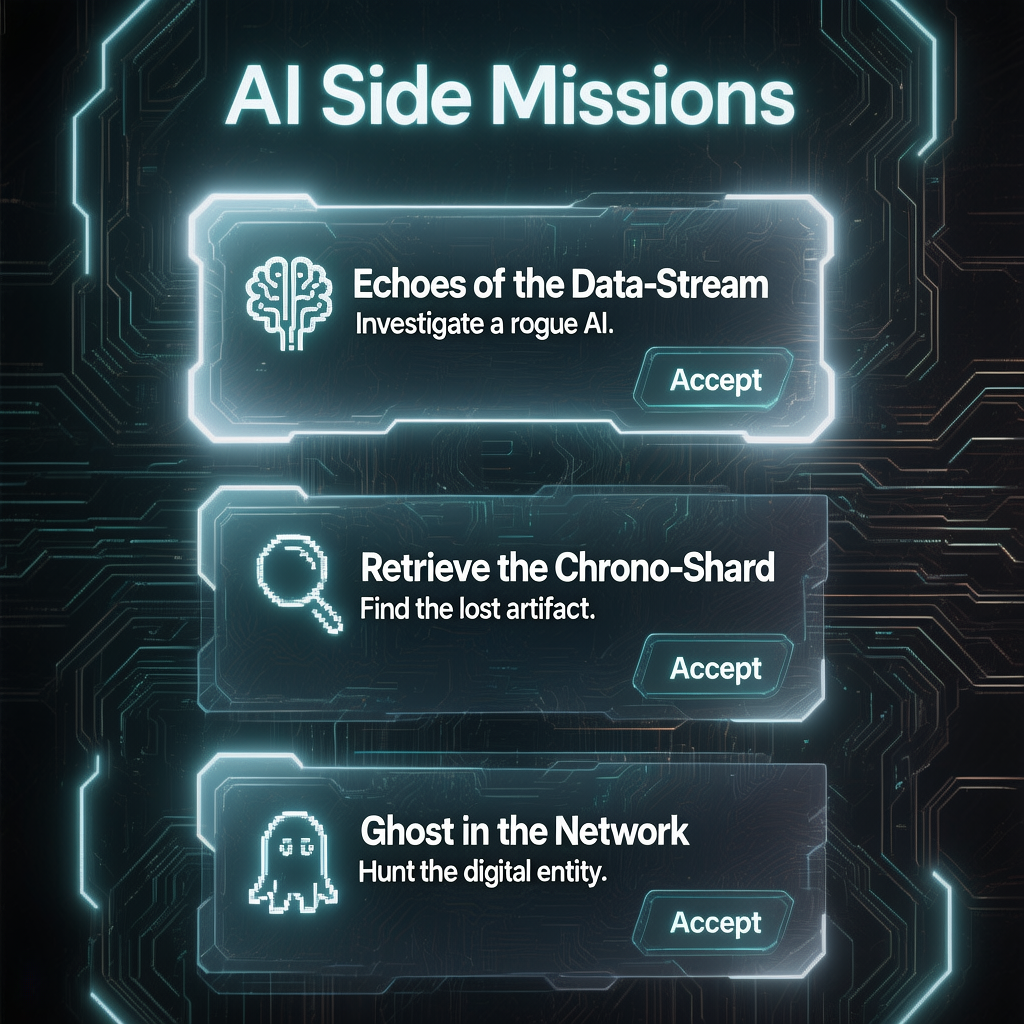
There’s a moment every dedicated gamer knows well. You’ve explored every corner of the map, completed every quest, and suddenly the world that felt alive just hours ago feels strangely empty. I remember finishing The Witcher 3’s final side quest and feeling genuinely sad that there was nothing left to discover. That bittersweet feeling may soon become a relic of gaming’s past, thanks to AI generated side missions.
The concept sounds almost too good to be true infinite content that never runs out, quests that adapt to your playstyle, and worlds that keep surprising you no matter how many hours you invest. But this technology isn’t science fiction anymore. It’s here, evolving rapidly, and reshaping how developers think about game content.
What Exactly Are AI Generated Side Missions?
Traditional side missions are hand crafted by writers and designers. Every dialogue line, objective, and reward is deliberately placed. This approach produces quality but comes with inherent limitations human teams can only create so much content, and eventually players consume it all.
AI generated side missions flip this model. Instead of pre scripted content, intelligent systems create quests dynamically based on game parameters, player behavior, and narrative frameworks established by developers. Think of it as giving the game a creative brain that can improvise within defined boundaries.
I first encountered this approach years ago in basic forms randomized fetch quests and procedurally assigned enemy camps. Honestly, those early attempts felt hollow. The technology has matured significantly since then.
How Modern Systems Actually Work

The sophisticated AI mission generation systems emerging today operate on multiple layers. At the foundation, developers establish what I’d call narrative guardrails character personalities, world lore, faction relationships, and storytelling conventions the AI must respect.
Machine learning algorithms then analyze patterns from existing hand crafted content, learning what makes missions engaging. They study pacing, reward structures, narrative arcs, and emotional beats. When generating new content, they attempt to replicate these qualities while introducing variation.
A game I’ve been following closely integrates player behavior analysis into this process. If you tend to prefer stealth approaches, the AI gradually generates more missions suited to that playstyle. If you ignore certain quest types, they appear less frequently. The system learns your preferences without you explicitly stating them.
The most impressive implementations connect generated missions to the broader game narrative. A random quest isn’t just “kill ten bandits” it becomes “eliminate the bandit group threatening the merchant who helped you earlier,” creating meaningful connections to your personal playthrough history.
Current Applications Worth Knowing
Several games have experimented with AI driven quest generation with varying success. No Man’s Sky uses procedural systems to create mission variety across its infinite universe, though player opinions on quality remain mixed. The missions serve their purpose but rarely feel handcrafted.
Shadow of Mordor’s Nemesis System, while not purely AI generation, demonstrated how dynamic systems could create personalized enemy encounters that felt like unique stories. Orcs remembered previous battles, developed grudges, and created emergent narratives no designer explicitly wrote. That system laid groundwork for what’s now possible.
More recently, indie developers have pushed boundaries further. A studio I spoke with last year was developing a fantasy RPG where an AI storyteller continuously generates interconnected questlines based on player choices. Each playthrough creates genuinely different narrative threads rather than variations on fixed content.
The technology has also found unexpected applications in game testing. Developers use AI to generate thousands of mission permutations, identifying bugs and balance issues before human players ever encounter them.
The Quality Question Nobody Can Ignore
Here’s where I have to be honest: quantity and quality exist in tension. The most beautifully written side mission in gaming history was crafted by a talented human writer who spent days perfecting every detail. AI systems cannot yet replicate that level of artistic intentionality.
What AI generation excels at is producing competent, varied content at scale. Missions that feel reasonably natural, appropriately challenging, and connected to game systems but rarely transcendent. For some players and game types, that’s perfectly fine. For others, it misses what makes side content memorable.
The best implementations I’ve experienced use hybrid approaches. Developers create key storylines and memorable set-piece missions by hand, while AI fills the space between with procedurally generated content that maintains engagement. This combination leverages strengths of both methods.
Player Reception Has Been Mixed
Talking to fellow gamers about this topic reveals divided opinions. Some embrace the promise of endless content, particularly in games they want to play indefinitely MMOs, survival games, and open world sandboxes. The prospect of never truly “finishing” appeals strongly to certain player types.
Others remain skeptical, even resistant. They argue that knowing content was machine generated diminishes their connection to it. There’s something psychologically different about experiencing a quest someone deliberately designed versus one an algorithm assembled. This perception challenge is real, even when generated content is objectively well-constructed.
Looking Ahead: What’s Coming Next
The trajectory suggests significant advancement over the next several years. Natural language processing improvements mean AI can write more convincing dialogue. Better understanding of narrative structure enables more complex, multi stage questlines. Integration with voice synthesis could eventually allow generated missions with unique spoken dialogue.
But technical capability isn’t the only factor. Player acceptance, developer adoption, and the fundamental question of what makes games meaningful all influence where this technology ultimately lands.
I suspect we’ll see AI generation become standard in certain genres while others deliberately avoid it as a design philosophy. Both approaches will find audiences. The gaming landscape is vast enough to accommodate different visions.
Ethical Considerations Worth Pondering
If AI generates significant portions of game content, what happens to narrative designers, quest writers, and content creators? This isn’t hypothetical it’s a genuine concern within the industry. Studios must navigate these transitions thoughtfully.
There’s also transparency to consider. Should players know which content was AI generated versus hand-crafted? Different players would answer differently, but the question matters.
Frequently Asked Questions
Do AI generated missions feel repetitive?
Early implementations often did. Modern systems using advanced algorithms create more variety, though sophisticated players may still recognize patterns over extended play.
Which games currently use AI generated side missions?
No Man’s Sky, various roguelikes, and several indie titles experiment with this technology. Major AAA implementations remain limited but increasing.
Can AI create story-driven quests comparable to human writers?
Not yet at the highest quality levels. AI excels at competent, varied content but rarely achieves the emotional depth of expertly crafted human writing.
Will this technology replace game writers?
Unlikely entirely. More probable is hybrid workflows where AI handles volume content while humans focus on key narrative moments.
Do players prefer AI generated or handcrafted content?
Preferences vary significantly. Some value infinite content; others prioritize quality and intentionality over quantity.
How do developers prevent AI missions from breaking game lore?
Through careful constraint systems, narrative guardrails, and extensive testing. Well-designed systems respect established world rules while generating new content.