
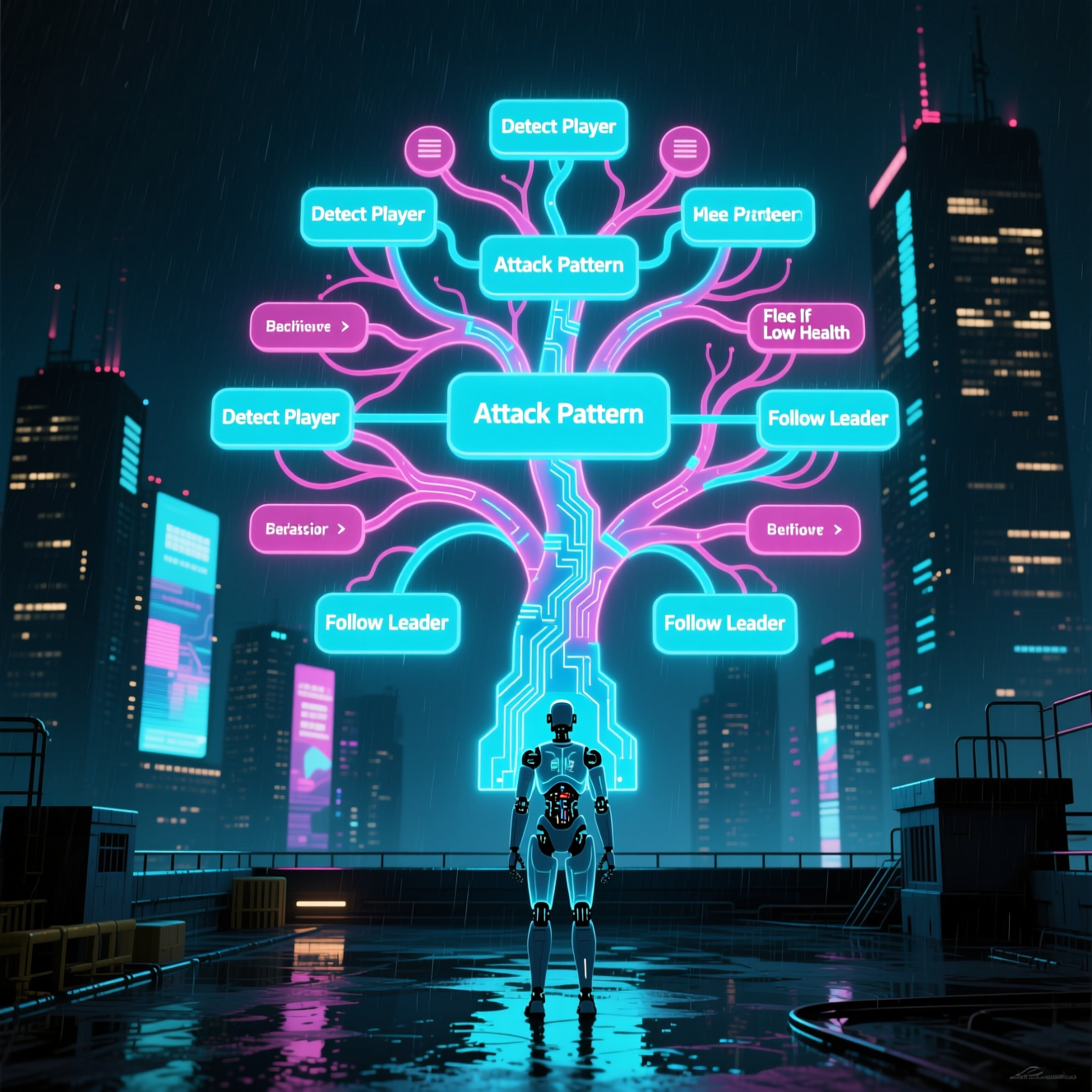
The first time I truly understood behavior trees, I was staring at a diagram that looked like an upside down family tree. Boxes connected by lines, branching downward into increasingly specific actions. It seemed almost too simple to power the complex enemy behaviors I’d admired in countless games.
But that’s exactly what makes behavior trees brilliant. They take complicated decision making and organize it into something humans can actually read, modify, and debug without losing their minds.
After years of studying game AI architectures, I can say confidently that behavior trees represent one of the most important advances in how we design intelligent game characters. Let me break down why they’ve become the industry standard.
The Basic Concept Explained
Think of a behavior tree as an organizational chart for decisions. At the top sits a root node the starting point for every evaluation. Below it, branches split into smaller sections, each handling different aspects of character behavior.
The tree gets evaluated from top to bottom, left to right. The system checks each node, determines success or failure, and moves accordingly. When a character needs to decide what to do, the tree runs through its branches until finding an appropriate action.
What makes this powerful is modularity. Each branch operates independently. You can swap combat behaviors without touching patrol logic. You can add new abilities without restructuring everything else. The organization mirrors how humans naturally categorize behaviors.
Understanding the Node Types
Behavior trees use several node types, each serving distinct purposes.
Composite nodes control flow between children. Selectors try each child until one succeeds perfect for fallback behaviors. Sequences require all children to succeed in order ideal for multi-step actions. These two node types form the backbone of most trees.
Decorator nodes modify child behavior. They might invert success to failure, repeat actions multiple times, or add conditional checks before execution. Think of them as modifiers wrapping around other nodes.
Leaf nodes actually do things. They execute actions like “play attack animation” or check conditions like “is player visible.” Every branch eventually terminates in leaf nodes where real work happens.
A simple example: a guard might have a selector choosing between combat, investigation, and patrol branches. The combat branch contains a sequence requiring target acquisition, weapon readying, and attack execution. Each step must succeed before the next begins.
The Games That Pioneered This Approach

Halo 2 deserves credit for popularizing behavior trees in mainstream game development. Bungie’s AI programmer Damian Isla presented their approach at the 2005 Game Developers Conference, and the industry paid attention.
The Covenant enemies in Halo demonstrated what behavior trees could achieve. Elites coordinated squad tactics, Grunts panicked when leaders fell, and Jackals maintained shield formations. Each behavior emerged from tree structures that designers could visualize and tweak.
Unreal Engine later integrated behavior trees as a core feature, making the approach accessible to countless developers. Their visual editor lets designers build trees by dragging nodes and connecting branches. You don’t need programming expertise to create sophisticated character behaviors.
Understanding the Node Types
Behavior trees use several node types, each serving distinct purposes.
Composite nodes control flow between children. Selectors try each child until one succeeds perfect for fallback behaviors. Sequences require all children to succeed in order ideal for multi-step actions. These two node types form the backbone of most trees.
Decorator nodes modify child behavior. They might invert success to failure, repeat actions multiple times, or add conditional checks before execution. Think of them as modifiers wrapping around other nodes.
Leaf nodes actually do things. They execute actions like “play attack animation” or check conditions like “is player visible.” Every branch eventually terminates in leaf nodes where real work happens.
A simple example: a guard might have a selector choosing between combat, investigation, and patrol branches. The combat branch contains a sequence requiring target acquisition, weapon readying, and attack execution. Each step must succeed before the next begins.
The Games That Pioneered This Approach
Halo 2 deserves credit for popularizing behavior trees in mainstream game development. Bungie’s AI programmer Damian Isla presented their approach at the 2005 Game Developers Conference, and the industry paid attention.
The Covenant enemies in Halo demonstrated what behavior trees could achieve. Elites coordinated squad tactics, Grunts panicked when leaders fell, and Jackals maintained shield formations. Each behavior emerged from tree structures that designers could visualize and tweak.
Unreal Engine later integrated behavior trees as a core feature, making the approach accessible to countless developers. Their visual editor lets designers build trees by dragging nodes and connecting branches. You don’t need programming expertise to create sophisticated character behaviors.
Crysis pushed environmental awareness through behavior trees. Enemies evaluated cover quality, flanking opportunities, and teammate positions before deciding actions. The trees processed complex spatial information while remaining maintainable by designers.
Why Developers Prefer This Architecture
Readability stands out as the primary advantage. Looking at a well organized behavior tree, you can trace exactly how a character makes decisions. That transparency proves invaluable during development when behaviors inevitably need adjustment.
I’ve watched designers spend hours debugging state machine spaghetti dozens of states connected by tangled transition lines. Behavior trees eliminate that chaos through hierarchical organization. Problems become isolated to specific branches rather than spreading through interconnected states.
Reusability accelerates development significantly. Created a good “take cover” subtree? Drop it into any character type. Built effective patrol logic? Share it across enemy variants. Studios develop libraries of proven behaviors that designers remix for new characters.
The architecture also handles interruption gracefully. When something urgent happens like taking damage higher priority branches can abort lower-priority actions cleanly. Characters respond to changing circumstances without awkward behavioral glitches.
Real Limitations Worth Acknowledging
Behavior trees aren’t perfect solutions. Complex characters require massive trees that become unwieldy despite good organization. Some productions feature trees with thousands of nodes requiring dedicated tools just to navigate.
Reactivity can suffer too. Because trees evaluate from the root each cycle, characters sometimes appear indecisive. They might start one action, reevaluate, switch to another, then switch back. Developers implement various solutions cooldowns, commitment timers, hysteresis but the underlying tension exists.
Memory and context present ongoing challenges. Pure behavior trees don’t inherently remember past decisions or track long-term goals. Designers bolt on blackboard systems and memory structures, but integration requires careful planning.
The learning curve for effective tree design also surprises many teams. Building functional trees is easy. Building elegant, maintainable, high performance trees takes experience. I’ve seen promising projects struggle because designers created technically correct but practically unmanageable structures.
Modern Evolution and Hybrid Approaches
Contemporary game AI rarely uses pure behavior trees. Instead, developers combine trees with other systems to leverage multiple strengths.
Utility systems pair naturally with behavior trees. Rather than fixed priority ordering, utility scores determine which branches receive evaluation priority. Characters dynamically weight options based on circumstances rather than following rigid hierarchies.
Goal-oriented action planning sometimes drives high level decisions while behavior trees handle execution details. The planner determines what to accomplish; the tree determines how to accomplish it.
Machine learning occasionally trains on behavior tree outputs, learning when certain branches prove most effective. The tree provides structure; learning optimizes selection within that structure.
The Last of Us Part II exemplifies modern hybrid approaches. Enemies demonstrate remarkable situational awareness, coordinating searches, communicating discoveries, and adapting tactics. Behavior trees provide the organizational framework, but supplementary systems add dynamic elements that pure trees couldn’t achieve.
Looking Forward
Behavior trees will likely remain foundational for years to come. Their organizational clarity and practical debuggability solve problems that fancier approaches often ignore.
The tools continue improving. Visual editors become more sophisticated. Debugging visualizations show exactly which nodes activate during gameplay. Documentation features help teams maintain increasingly complex trees.
For anyone interested in game AI, understanding behavior trees is non-negotiable. They represent how the industry actually builds character intelligence not in research papers, but in shipped products millions of players enjoy.
Frequently Asked Questions
What is a behavior tree in gaming?
A behavior tree is a hierarchical structure organizing character decision-making through nodes that control flow, check conditions, and execute actions.
How do behavior trees differ from state machines?
Behavior trees use hierarchical evaluation with modular branches, while state machines rely on interconnected states with explicit transitions between them.
Which games use behavior trees?
Halo series, Crysis, The Last of Us, and most Unreal Engine games use behavior tree systems for character AI.
Are behavior trees difficult to learn?
Basic concepts are accessible, but designing elegant, maintainable trees for complex characters requires experience and practice.
What are the main components of behavior trees?
Composite nodes (selectors, sequences), decorator nodes (modifiers), and leaf nodes (actions, conditions) form the primary building blocks.
Can behavior trees create truly intelligent AI?
They create believable, responsive characters but work best combined with other systems for genuinely sophisticated behaviour.